
A2F 2026: Making financial inclusion work harder for Nigerians
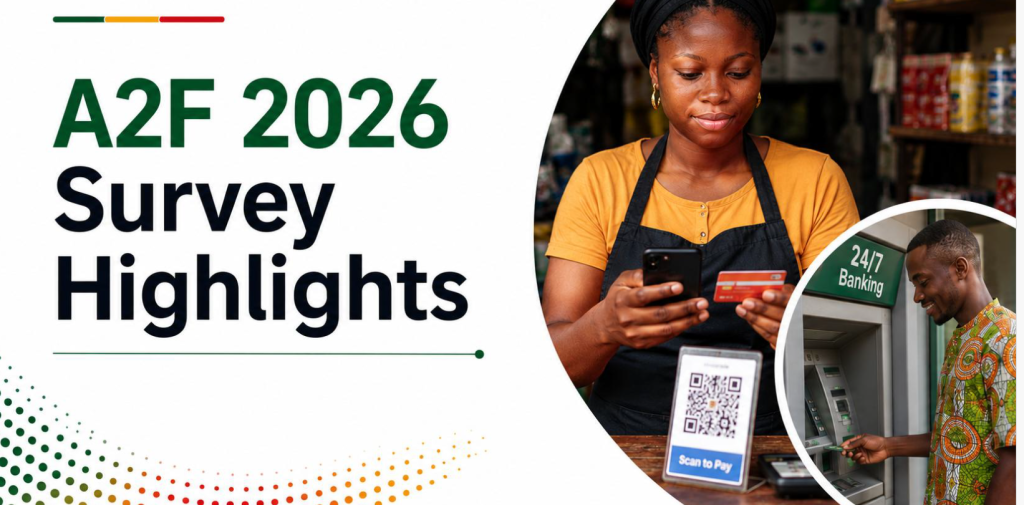
More Nigerians are connected to financial services. The next challenge is to turn those relationships into stronger livelihoods, protection and financial security. Consider Rofiat, a 43-year-old single mother raising four children and running a small business. She has had a bank account for more than 20 years. It helps her receive payments, move money and […]
Beyond the Account Number: Why Reliability is the Real Frontier for Nigeria’s Financial Health
Financial inclusion in Nigeria has reached a milestone—79% of Nigerian adults, representing over 94 million people, now have access to financial services. Yet, beneath this headline figure lies a sobering reality: 52% of adults have less than a month of financial buffer if their income stops, and nearly half experienced a major economic shock in […]
From Access to Progress: Making Financial Inclusion Work for Nigerians
Imagine a small business owner who has a bank account, receives payments digitally and can access credit when cash gets tight. On paper, she is financially included. But when a family emergency comes, business sales slow down or an unexpected bill arrives, she has little savings to fall back on. She borrows to cope, rather […]
Designing Financial Services That Work for Women: Lessons from Women’s Associations
Designing Financial Services That Work for Women: Lessons from Women’s Associations By Nafisa Atiku-Adejumo, GCE Manager, EFInA In March of this year, Enhancing Financial Inclusion and Advancement (EFInA) convened its International Women’s Month gathering under the theme, ‘Gather, Gain & Grow.’ It was a much-needed conversation focused on bridging the divide between women’s savings associations, financial regulatory agencies, development organisations, and financial service providers. This conversation highlighted an understated fact: women’s savings associations are among […]
Rethinking Financial Inclusion Success: Why Climate Resilience Must Be a Core Metric in Nigeria
Rethinking Financial Inclusion Success: Why Climate Resilience Must Be a Core Metric in Nigeria By Babjide Daini, MEL Manager, EFInA Nigeria’s financial inclusion story is often told as one of steady progress. More people have bank accounts, digital payments are expanding, and access is improving. By conventional measures, the system appears to be working. But […]
Agent-Led Innovation: Building on Trusted Intermediaries for Financial Inclusion
Agent-Led Innovation: Building on Trusted Intermediaries for Financial Inclusion By Norah Igwe, Programme Lead, EFInA In the bustling markets of Anambra, the roadside kiosks of Kano, and the remote villages of the Middle Belt, a quiet revolution is unfolding. It isn’t taking place on high-end smartphones or inside air-conditioned bank branches. Instead, millions of small business owners are driving […]
What Good Is Economic Growth Without Household Resilience?
What Good Is Economic Growth Without Household Resilience? By Jennifer Mairo, CEO, Joy Inc. A thought I heard recently on a viral podcast has stayed with me: that the primary role of government is security and welfare. It struck me because, in public discourse, we tend to give far more oxygen to other big themes, politics, elections, […]
Unlocking Inclusive Growth through Cluster Finance for Productive Women Segments
Unlocking Inclusive Growth through Cluster Finance for Productive Women Segments By Emezino Afiegbe, Lead, Gender Centre of Excellence, EFInA Evidence continues to demonstrate the significant economic value and growth opportunities latent within the women’s segment in Nigeria. It is estimated that a third of women in Nigeria own nano, micro, and small enterprises, and this […]
Racing to Geo-tag POS in Nigeria: Why Legitimate Agents’ Economic Activities Need Protection.
Nigeria’s Urban-Rural Dichotomy and the Financial System Infrastructure Challenge Immanuel Umukoro, Policy and DFS Manager, EFInA On August 25th, 2025, the Central Bank of Nigeria (CBN) released a circular on the Migration to ISO 20022 Standard for Payment Messaging and Mandatory Geo-Tagging of Payment Terminals. The geo-tagging objective was clear: all terminals should be tied to known locations so that suspicious movement could be detected more easily, and fraud investigations, dispute resolution, oversight, and […]
Nigeria’s Urban-Rural Dichotomy and the Financial System Infrastructure Challenge.
Nigeria’s Urban-Rural Dichotomy and the Financial System Infrastructure Challenge By Chioma Nwaiwu and Oluwatomi Eromosele Nigeria’s financial inclusion story reflects hard-won progress, but is overshadowed by a persistent divide. According to the A2F 2023 Survey, formal financial inclusion reached 64% in 2023, up from 56% in 2020 and approaching the National Financial Inclusion Strategy’s 65% formal inclusion target for 2024. Yet these national averages […]